How Much Sound Deadening Do I Need? Coverage Calculator Guide
One of the most common pre-purchase questions: how many square feet of sound deadening do I actually need? The answer depends on which areas you’re treating and what coverage percentage you’re targeting. Most builds fall into one of three scenarios.
Coverage Percentage vs Full Coverage
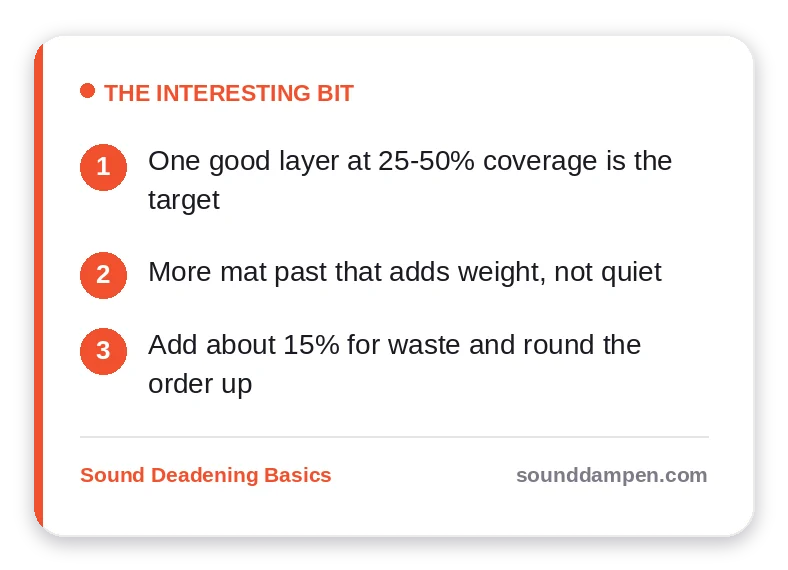
You don’t need to cover every square inch of a panel to achieve effective damping. Research and community testing consistently shows that covering 25–30% of a panel’s surface area achieves approximately 70–80% of the maximum possible damping. Coverage beyond 40–50% produces diminishing returns.
Exception: trunk lids and thin horizontal panels benefit from higher coverage because they’re light and resonate easily at low amplitude. Full coverage on a trunk lid is worthwhile.
Square Footage by Treatment Area (Mid-Size Sedan)
These are approximate figures for a typical mid-size sedan at 25–35% coverage:
- Both front doors (inner skins): 8–12 sq ft
- Both rear doors (inner skins): 8–10 sq ft
- Floor (front + rear footwells + tunnel): 20–30 sq ft
- Trunk floor: 8–12 sq ft
- Trunk lid: 8–10 sq ft (full coverage)
- Rear wheel wells: 5–8 sq ft
- Firewall (accessible sections): 5–10 sq ft
- Roof: 15–20 sq ft
Recommended Buy Quantities by Build Scope
- Doors only: 36 sq ft pack (covers both front and rear doors with material to spare)
- Doors + trunk: 50 sq ft — buy two 36 sq ft packs or a 50 sq ft bulk pack
- Full floor + doors: 80–100 sq ft
- Full car treatment: 100–120 sq ft depending on vehicle size
Buy a bit more than your calculation suggests — you’ll cut pieces that don’t fit perfectly and it’s better to have leftover material than to run short mid-install.
Shop by pack size: Kilmat bulk packs on Amazon →
Why More Isn’t Better
Damping is governed by diminishing returns. The first layer of mat on a bare panel does almost all the work; a second full layer on top adds weight and cost while contributing only a small additional reduction. Likewise, going from 30 percent coverage to 100 percent coverage roughly triples your material spend for a single-digit-percentage improvement. Aim for one good layer over the largest flat sections and stop.
Worked Example: A Compact Sedan
For a compact sedan you might budget roughly 10 to 12 square feet for both front doors, 6 to 8 for the trunk floor and lid, and 35 to 45 for a full floor if you go that far. Add it up before you buy: doors and trunk together land near 18 to 20 square feet, so a single 36-square-foot pack covers them with margin and leaves a start on the floor.
Buying in Bulk vs By the Sheet
Larger packs almost always cost less per square foot than small sheet bundles, and because the mat keeps indefinitely, buying one size up is rarely wasted — leftover mat finds a home on a rattly tailgate or a buzzing license-plate panel. The expensive mistake is under-buying and pausing a half-finished install for a week while a second order ships.
Coverage by Goal, Not by Habit
How much you need depends on what you are chasing. For rattle and resonance control, 25 percent coverage of the worst panels is often enough. For a noticeable road-noise drop, push the floor toward 40 to 50 percent. For a serious audio build, the doors and trunk benefit from heavier coverage because they are being driven hard by the speakers. There is no single right number — match coverage to the job.
This is why buying a one-size kit can leave you over-treating quiet panels and under-treating loud ones. Plan per area instead of buying a single blanket amount for the whole car.
Account for Waste and Awkward Cuts
Real panels are not rectangles. Door skins have service holes, the floor has tunnels and brackets, and every area needs trimming around hardware. Add roughly 15 percent to your raw area estimate to cover offcuts and the occasional mis-cut, and round up to the next pack size.
Running short is the expensive outcome — a stalled, half-treated install waiting a week on a second order. Leftover mat, by contrast, always finds a use on a tailgate, a wheel well, or a buzzing panel you discover later.
Round Up and Move On
Once you have estimated your panels, applied your coverage target, and added waste, round up to the next pack and stop second-guessing the number. Mat keeps indefinitely, so a small surplus is never wasted, while a shortfall stalls the whole job. The goal of a coverage calculation is to buy confidently once — not to shave the order so close that you run out halfway through a door.
If you are still unsure, err toward a little extra on the doors and floor, the two areas where heavier coverage actually pays off, and keep the leftovers for the rattly panels you will inevitably find later.
Related: How to Sound Deaden Car Doors
Related: How to Sound Deaden a Car Floor
Once you know your coverage: Damplifier Pro for the mat and Luxury Liner Pro for the barrier is the combination that does the work. Direct at secondskinaudio.com, 10 percent off with code FKNSNDIT10. More in our Second Skin review.
Disclosure: affiliate links. We may earn a commission on Second Skin orders placed with code FKNSNDIT10, at no extra cost to you.
[faq]
Q: Do I need full coverage or partial?
A: Partial coverage (25–35%) is standard practice and achieves 70–80% of maximum damping. Full coverage is only worth doing on trunk lids and thin flat panels that resonate easily.
Q: How many square feet for just the doors?
A: Both front and rear doors on a mid-size sedan: 18–22 sq ft. A 36 sq ft pack handles this comfortably.
Q: What if I buy too much?
A: Extra material is always useful — deadening mat doesn’t expire and can be used for a second car or to add coverage in areas you initially skipped. Better to over-buy than run short.
[/faq]
Deadening for a car audio build? See how much deadening a system actually needs.
Related reading
- How Much Sound Deadening Do I Need? A Coverage Calculator Guide
- Sound Deadening an Electric Car: Why EVs Need It More, Not Less
- Sound Deadening Roller Tools: Do You Need One and Which to Get
- Sound Deadening for Cars: What It Is and Whether You Actually Need It
Recommended Gear
As an Amazon Associate, this site earns from qualifying purchases made through the links below.
- Shop butyl sound deadening mats — The core first layer for any door, floor, or trunk deadening job
- Compare deadener rollers on Amazon — Full adhesion needs rolling — hand pressure leaves air pockets