Does Sound Deadening Reduce Road Noise? Realistic Expectations

Sound deadening reduces road noise — but the amount of reduction varies significantly based on where you apply it, what’s generating the noise in your specific vehicle, and how thorough the treatment is. Understanding the mechanism helps set realistic expectations before you commit to the project.

What Sound Deadening Actually Does to Road Noise
Road noise reaches the cabin through two paths: structure-borne transmission (vibration traveling through metal panels and suspension components into the cabin floor) and airborne transmission (sound waves traveling through the air and passing through panels into the cabin).
Butyl deadening mat primarily addresses the first path — it controls panel vibration that would otherwise radiate road noise into the cabin. It has limited effect on airborne transmission. This distinction explains why a floor treatment dramatically reduces tire roar (which is largely structure-borne on most vehicles) but doesn’t eliminate wind noise (primarily airborne).
Realistic Reduction Numbers
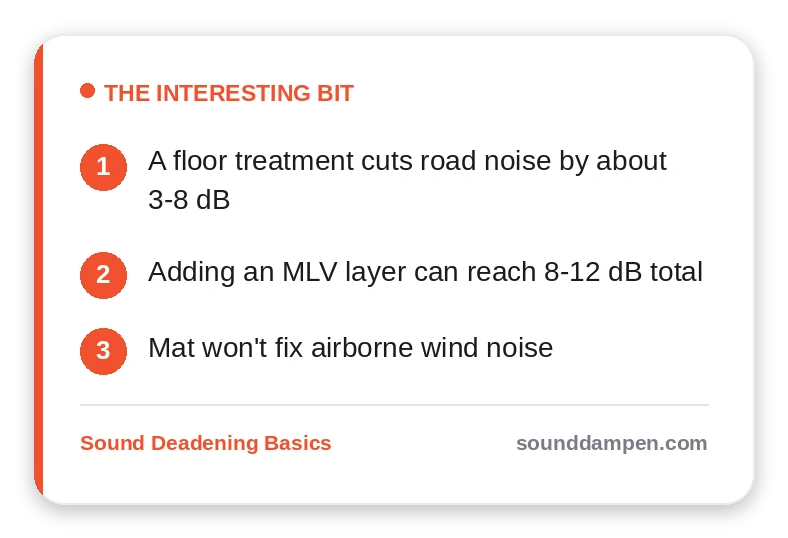
A floor treatment with quality 80 mil mat on a vehicle with minimal factory deadening typically produces 3–8 dB of road noise reduction at highway speed — measurable with an SPL meter and clearly audible. A 3 dB reduction represents roughly half the perceived loudness of the noise source.
Adding a mass-loaded vinyl layer over the deadening mat can push this to 8–12 dB total — at which point the difference is dramatic and the cabin feels genuinely transformed.
Which Noise Sources Are Most Affected
- Tire roar — significantly reduced by floor and wheel well treatment (mostly structure-borne)
- Road surface drone — significantly reduced by floor treatment
- Suspension noise — partially reduced; depends on transmission path
- Wind noise — minimally affected by deadening mat; primarily requires door seal work
- Exhaust drone — reduced by firewall treatment; depends heavily on exhaust routing
Tires: The Noise Source You Can’t Deaden Away
No amount of mat changes the sound a tire makes against pavement — it only changes how much of that sound reaches your ears. Aggressive, all-terrain, and cheap hard-compound tires generate far more roar than a quiet touring tire, and on a loud set of tires even a thorough floor treatment will leave more noise than the same car on quiet rubber. If road noise is your enemy, your next set of tires is as much a part of the solution as the deadening.
Stacking Treatments for Bigger Gains
A single butyl floor treatment buys you a few decibels; the dramatic transformations come from stacking. Butyl mat on the bare metal kills vibration, a closed-cell foam decoupler goes on top, and a mass-loaded vinyl barrier blocks the airborne component. Each layer addresses a different path, and together they can roughly double the reduction of mat alone. The trade is weight, cost, and labor — full stacks are for people chasing maximum quiet, not a quick improvement.
Measuring Your Results
A free SPL meter app on your phone is enough to document a before-and-after. Record cabin noise at a steady highway speed on the same stretch of road, in similar weather, before and after the work. A 3 dB drop is real and corresponds to roughly half the perceived noise energy; 6 to 8 dB on a previously bare floor is a result you will feel as much as measure. Same road, same speed, same day is the key to a fair comparison.
Why Some Cars Improve More Than Others
Two cars given the identical treatment can show very different results, and the variable is where they started. A budget car or an older vehicle with thin, degraded factory deadening has a lot of headroom — there is real noise to remove, so the before-and-after is dramatic. A modern car that already came well insulated has less to gain, because the factory already did the easy work. Manage your expectations against your starting point.
Tires, suspension, and even the road surface you drive on most also shape the outcome. The same treated car is louder on coarse concrete with aggressive tires than on smooth asphalt with touring tires.
Treat the Whole Path, Not One Panel
Road noise reaches you through several paths at once — the floor, the wheel wells, the doors, and the firewall — so treating only one and expecting silence leads to disappointment. The dramatic results come from addressing the main paths together: floor and wheel wells for structure-borne tire roar, doors for resonance, and a barrier layer where airborne noise dominates.
Think of it as plugging leaks in a boat. Sealing one while three others stay open changes little; closing the big ones together is what transforms the cabin.
What You’ll Want on Hand
This site is an Amazon Associate and may earn a commission from qualifying purchases via these links.
- Shop butyl sound deadening mats — The core first layer for any door, floor, or trunk deadening job
- Compare mass loaded vinyl (MLV) on Amazon — The barrier layer that actually blocks road noise after the butyl goes down
The Honest Summary
Sound deadening reliably reduces road noise — typically a few decibels from a floor treatment and substantially more from a full layered stack — but it manages noise rather than eliminating it. Set expectations against your starting point, treat the main paths together, and remember that your tires are as much a part of the result as the mat. Do that and the cabin will feel genuinely transformed; expect silence and you will be let down.
If road noise is the specific thing driving you crazy, the highest-value moves are a floor-and-wheel-well treatment and, at your next replacement, a quieter set of tires. Together they address both how the noise is made and how much of it reaches you.
Related: How to Sound Deaden a Car Floor
Related: Sound Deadening vs Sound Proofing
[faq]
Q: How much quieter will my car be after sound deadening?
A: A floor treatment on a vehicle with minimal factory deadening typically reduces road noise by 3–8 dB — clearly audible and meaningful for daily driving comfort. Adding a foam or MLV layer over the mat can achieve 8–12 dB total.
Q: Will sound deadening eliminate wind noise?
A: No — wind noise is primarily airborne and enters through door seals and gaps, not through panel vibration. Door seal replacement and window sealing addresses wind noise; deadening mat doesn’t.
Q: What’s the fastest improvement for road noise?
A: Floor treatment — it’s the highest-impact single treatment for road noise. Wheel well covers are a close second and often overlooked.
[/faq]
Where to start: the floor and adding mass loaded vinyl give the biggest road-noise wins.
Related reading
- Firewall Sound Deadening: Does It Actually Reduce Engine Noise
- Sound Deadening an Electric Car: Why EVs Need It More, Not Less
- How to Remove Old Sound Deadening Without Wrecking Your Panels
- Does the Foam on Tri-Layer Sound Deadening Actually Do Anything?