Sound Deadening a Pickup Truck: Cab and Bed Priorities

Pickup trucks present a different sound deadening challenge than cars — body-on-frame construction, large cab panels, rear-end noise from the truck bed, and often louder tires combine to create a specific acoustic profile that requires a targeted approach.

Unique Challenges with Trucks
- Cab rear wall — the firewall between the cab and truck bed is a major noise transmission point; this is unique to pickup configuration
- Large roof panel — truck cab roofs are large flat surfaces that resonate significantly; rain noise on an untreated truck roof is loud
- Floor height — body-on-frame construction puts more mechanical noise paths into the cab than unibody vehicles
- Bed drumming — an untreated steel truck bed resonates at highway speed, transmitting noise into the cab through the rear cab wall
Priority Treatment Order for Pickup Trucks
1. Cab Floor
Same highest-priority treatment as any vehicle. Floor noise from the road surface and drivetrain is the dominant problem. Use 80 mil coverage at 40–50% on the cab floor.
2. Rear Cab Wall
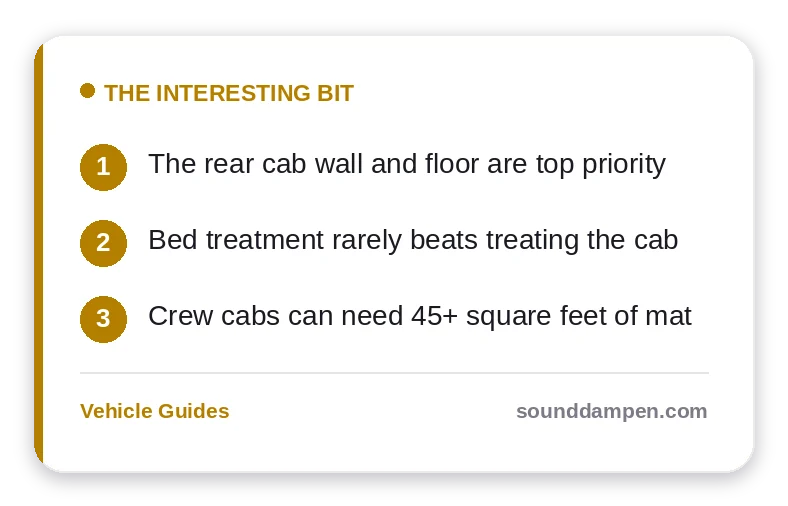
This is the treatment most specific to trucks. The rear wall between the cab and the bed transmits road noise, wind noise, and bed resonance directly into the passenger compartment. Treating this panel — accessible by removing the rear seat — makes a significant difference in rear-end noise on the highway.
3. Doors
Standard door treatment — same approach as any vehicle. Truck doors are typically larger than car doors, so budget 15–20 sq ft for both front doors on a full-size truck.
4. Roof
Truck roofs are worth treating — they’re large, flat, and resonate easily. Particularly high-value for rain noise reduction. Access requires dropping the headliner, which is a significant job but straightforward on most full-size trucks.
Truck Bed Treatment
Treating the bed floor itself reduces the resonance that transmits through the rear cab wall. Spray-on bed liner has minimal acoustic benefit — it’s too thin. A purpose-built bed mat with deadening properties (or applying butyl mat under a bed rug) makes a real difference. This is most relevant for work trucks that carry loads that amplify bed resonance.
Regular Cab vs Crew Cab
Cab size changes the math. A regular cab is mostly a rear wall and two doors, so a small amount of mat goes a long way and the rear cab wall becomes the single most important panel — it sits inches from the drivetrain and reflects a lot of noise forward. A crew cab adds a second row, more floor, and rear doors, which means more square footage but also more opportunity, since rear-seat passengers feel the benefit of a treated rear floor directly.
Bed Treatment: Worth It or Not
Deadening the bed only helps if noise from it actually reaches the cabin, which it mostly does through the rear cab wall. For most trucks, treating the rear cab wall from inside the cab returns far more quiet per dollar than coating the bed. Bed treatment makes sense in specific cases — a toolbox or drawer system that drums, or a bed-mounted subwoofer — but as a general quieting move it is low priority compared to the cab floor and rear wall.
Realistic Truck Cab Budget
A regular cab floor, rear wall, and doors usually run 25 to 35 square feet of mat; a crew cab can push past 45 once you include the rear floor and doors. Trucks reward treatment because they start loud — body-on-frame construction and big tires put a lot of structure-borne noise into the cab — so the before-and-after tends to be dramatic for the material invested.
Engine and Drivetrain Noise in Trucks
Body-on-frame trucks transmit a particular kind of low-frequency drone from the driveline and the gaps where the cab mounts to the frame. The rear cab wall and the cab floor over the transmission tunnel are where most of that energy enters, which is why they top the priority list. Treating them with butyl mat, and adding a barrier layer on the floor, addresses the deep drone that thin door treatment alone never touches.
Diesel trucks benefit even more, since the engine itself puts far more noise into the firewall and floor than a gas engine does.
Don’t Block the Drains or Wiring
Truck floors have drain plugs and a maze of wiring and seat-mount hardware. Pull the seats and carpet, plan your sheets around the bolt holes and harness routing, and keep mat off the drain points. Take photos before disassembly so the wiring and trim go back exactly as they came out.
Done methodically, a cab treatment turns a loud work truck into a comfortable daily driver — and because trucks start so loud, the before-and-after is one of the most dramatic in the hobby for the material invested.
Treat a truck as the high-return project it is. Because the cab starts so loud, the rear wall and floor return more audible quiet per square foot than almost any car, and a methodical cab treatment turns a fatiguing work truck into a comfortable daily driver. Budget for the larger square footage a truck demands, stage the work across a couple of weekends, and the payoff is among the most dramatic in the hobby.
Related: How Much Sound Deadening Do I Need? Coverage Calculator Guide
Related: Best Sound Deadening Mat for Cars
[faq]
Q: How much material do I need for a full-size truck cab?
A: A full-size crew cab (floor, doors, rear wall) typically runs 60–80 sq ft. Buy two 36 sq ft packs for a partial treatment or go larger for full coverage.
Q: Should I treat the truck bed?
A: For daily driven trucks, treating the bed floor reduces the resonance that transmits into the cab. It’s lower priority than the cab treatments but makes a real difference on highway trips.
Q: Is truck roof treatment worth the effort?
A: Yes, particularly for rain noise. Truck roofs are large, thin, and resonate clearly during rain. If you’re doing a thorough build, include the roof.
[/faq]
Step-by-step guides: doors and the floor — the two highest-impact areas.
Related reading
- Sound Deadening an Electric Car: Why EVs Need It More, Not Less
- How to Remove Old Sound Deadening Without Wrecking Your Panels
- Does the Foam on Tri-Layer Sound Deadening Actually Do Anything?
- Can You Put New Sound Deadening Over Old CLD?
Recommended Gear
As an Amazon Associate, this site earns from qualifying purchases made through the links below.
- Browse butyl sound deadening mats on Amazon — The core first layer for any door, floor, or trunk deadening job
- See current mass loaded vinyl (MLV) options — The barrier layer that actually blocks road noise after the butyl goes down
- Shop closed-cell foam — The decoupler layer between butyl and MLV or panels