Dynamat vs Kilmat: Which Sound Deadener Is Worth the Price Difference
Dynamat is the name everyone knows in automotive sound deadening — and Kilmat is what most budget-conscious builders reach for instead. The price gap between them is significant: Dynamat Xtreme runs roughly $3–4 per square foot, while Kilmat comes in around $0.60–0.80 per square foot. For a full car treatment covering 50+ square feet, that’s a $150 project versus a $600+ one.
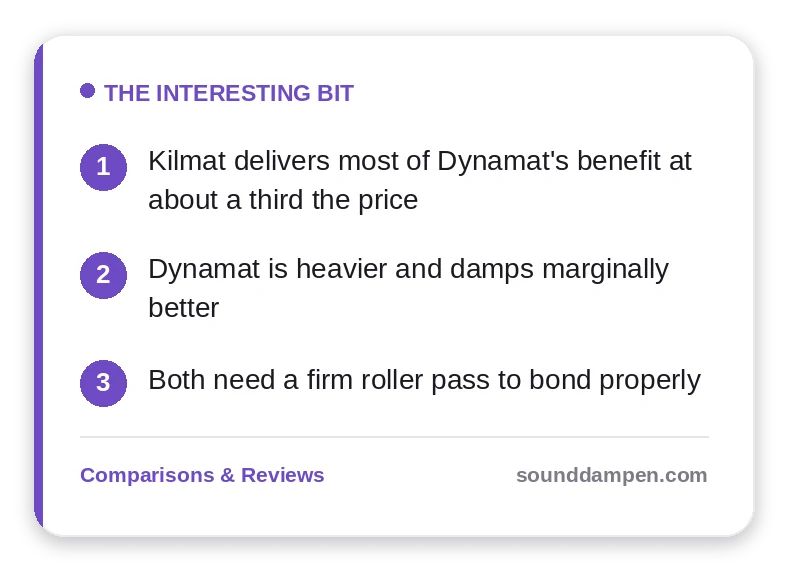
Quick verdict: Kilmat performs at 85–90% of Dynamat’s level for most real-world applications. Unless you’re building a competition vehicle or doing a high-end luxury install where every decibel counts, Kilmat is the better value by a wide margin.

The Numbers: Thickness and Construction
Dynamat Xtreme is 67 mil thick (about 1.7mm) and uses a proprietary butyl compound with an embossed aluminum top layer. Kilmat is available in 50 mil and 80 mil versions — the 80 mil version is what most people compare against Dynamat.
Both use butyl rubber + aluminum foil construction. The difference is primarily in butyl compound quality, adhesive strength, and the mass of the aluminum layer. Dynamat’s foil is thicker and stiffer, which adds marginally more mass loading on top of the damping effect.
Real-World Performance Comparison
In independent lab testing and community comparisons, Dynamat Xtreme typically shows 3–5 dB better noise reduction than Kilmat 80 mil under controlled conditions. In a real car on a real road, that difference is audible in back-to-back testing but not dramatic in isolation.
Where Dynamat does show a clearer lead: adhesion in high-heat environments. Kilmat’s adhesive can become less aggressive above 120°F — relevant for firewall and floor applications in hot climates. Dynamat’s adhesive holds up better in those conditions.
When Dynamat Is Worth It
- Competition builds where every dB matters
- High-end daily drivers where you’re doing a full interior strip and want the best result
- Firewall and floor treatments in vehicles that get extremely hot (Southern summer climates, track cars)
- Situations where you’re paying labor — the Dynamat result per labor hour is better if installation cost is the bigger factor
When Kilmat Is the Right Call
- Budget builds where coverage area matters more than marginal performance
- First sound deadening project — get familiar with the process before committing to premium pricing
- Door treatments on daily drivers — the difference vs Dynamat is minimal here
- Any situation where you’re doing 50+ square feet — the savings fund the rest of the audio build
Weight and Heat Differences
Dynamat Xtreme is noticeably heavier than Kilmat for the same coverage, and that extra mass is part of why it damps slightly better — but it also adds more weight to a full-car install. For a doors-and-trunk treatment the difference is trivial; for a complete interior it can add up to several extra pounds. Both products also include an aluminum constraining layer that reflects radiant heat, so either one will take some of the summer bake out of a floor or firewall.
Installation Experience Compared
Dynamat’s adhesive is more aggressive and its foil is thicker and stiffer, which makes it conform cleanly to compound curves but harder to reposition once it touches metal. Kilmat is thinner and more forgiving for a beginner, though its lighter foil tears more easily if you are rough with it. Both need a firm roller pass to bond properly; neither sticks reliably to cold or dusty metal.
The Verdict for Most Builds
For a daily driver or a moderate audio build, Kilmat delivers most of Dynamat’s real-world benefit at roughly a third of the price, and the gap shrinks further once both are correctly rolled down. Dynamat earns its premium in a flagship build where you want the absolute best damping and do not mind paying for the brand’s consistency and support. Spend the savings from choosing Kilmat on a second area — doors plus floor with Kilmat beats doors alone with Dynamat.
Resale and Brand Support
Dynamat has been the industry reference for decades, and that name recognition carries real weight if you ever sell the car or the install — a documented Dynamat treatment reads as premium. Kilmat is newer and value-focused, with less brand cachet but a strong following among DIY installers who care more about results than logos.
Support differs too. Dynamat offers detailed install resources and a long track record of consistency between batches. Kilmat’s consistency is good but it is fundamentally a value product sold on price, so you are buying the mat, not a support ecosystem.
Neither company’s warranty is the deciding factor for most buyers, because a correctly installed butyl mat from either brand simply does not fail. The choice comes down to budget and how much the name on the foil matters to you.
One last practical point: buy whichever is cheaper on the day for the coverage you need, then spend any savings on treating a second area. Doors plus floor in Kilmat beats doors alone in Dynamat for real-world quiet, because covering more of the right panels matters more than a small per-panel edge in damping. The brand on the foil is far less important than how much of the car you actually treat.
Related: Sound Deadening on a Budget
Related: How to Sound Deaden Car Doors
Get Kilmat 80 mil: Kilmat on Amazon
Get Dynamat Xtreme: Dynamat on Amazon
[faq]
Q: Is Kilmat as good as Dynamat?
A: For most daily driver and enthusiast installs, Kilmat 80 mil gets you 85–90% of the performance at 20–25% of the cost. Dynamat has an edge in extreme heat and in competition-level applications.
Q: What thickness Kilmat should I buy?
A: The 80 mil version for doors and floors. The 50 mil is fine for trunk lids and roofs where you want lighter coverage.
Q: Can I mix Dynamat and Kilmat in the same car?
A: Yes — many builders use Kilmat for the bulk of the floor and trunk coverage, then use Dynamat for the firewall and door skins where adhesion quality matters most.
[/faq]
More matchups: Noico vs Kilmat on the budget end and Second Skin Damplifier vs Dynamat at the premium tier.
Related reading
- Does Cheap Sound Deadener Like Kilmat Actually Melt or Fail?
- Is Second Skin Worth It? An Honest Sound Deadening Review
- Butyl vs Asphalt Sound Deadener: Which One to Actually Buy
- Sound Deadening for Subwoofers: What Actually Makes a Difference
Gear Worth Having for This Job
Heads up: the links below are Amazon affiliate links, and qualifying purchases support this site at no extra cost to you.
- Compare butyl sound deadening mats on Amazon — The core first layer for any door, floor, or trunk deadening job
- Check out deadener rollers — Full adhesion needs rolling — hand pressure leaves air pockets