Sound Deadening vs Sound Proofing: What’s the Actual Difference
The terms get used interchangeably in product listings and forum discussions, but sound deadening and soundproofing are distinct concepts — and confusing them leads to buying the wrong products for the problem you’re trying to solve.
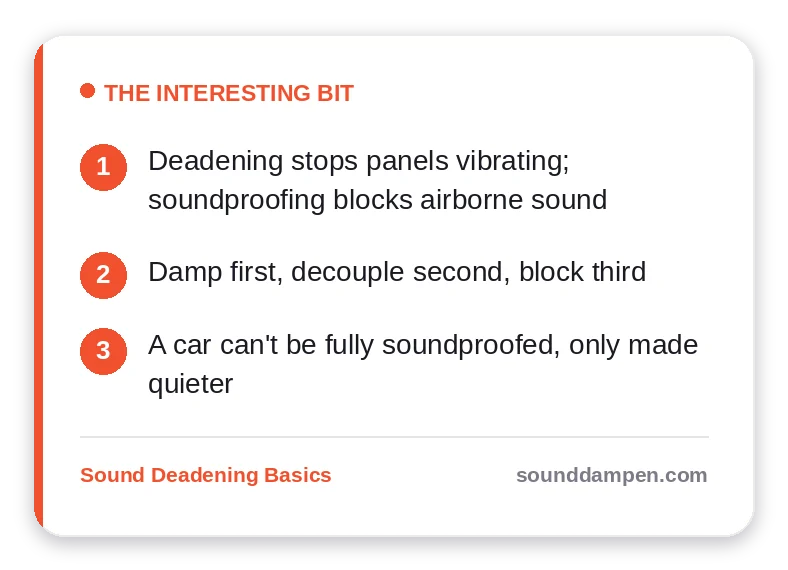
Sound deadening controls vibration and resonance in the panels of your vehicle. Soundproofing blocks airborne sound from passing through a surface. Cars need both, but they require different materials and approaches.
What Sound Deadening Does
Butyl mat products like Dynamat, Kilmat, and Noico are sound deadeners. They work by damping the vibration of metal panels — converting kinetic energy from panel flex into a small amount of heat through internal friction in the butyl layer.
What this solves: the hollow drumming sound when you hit a bump, the tinny resonance that muddies bass frequencies, and the sympathetic vibration of door panels at certain RPMs. It does not stop external noise from entering the cabin through the air — it stops panels from vibrating.
What Soundproofing Does
True soundproofing (mass-loaded vinyl, acoustic foam, closed-cell foam layers) reduces the transmission of airborne sound waves through a barrier. This is what addresses wind noise, road roar coming through the firewall, and the low-frequency rumble from the drivetrain.
Mass-loaded vinyl (MLV) is the most effective automotive soundproofing material. Applied under carpet or over the firewall, it adds significant mass to block sound transmission. It’s heavier and more expensive than deadener mat per square foot, but it addresses a different problem.
Closed-Cell Foam: Thermal and Acoustic Decoupling
A third layer many serious builds include: closed-cell foam applied over the deadening mat. This decouples the panel from the cabin air, reducing high-frequency airborne transmission. Products like Luxury Liner Pro combine MLV with closed-cell foam backing for a two-in-one solution.
The Layered Approach for Maximum Quiet
A proper quiet-car build uses all three in sequence:
- Layer 1 — Deadener mat directly on the bare metal panel (butyl + foil)
- Layer 2 — Closed-cell foam over the deadener (thermal and acoustic decoupling)
- Layer 3 — MLV or carpet as the final barrier layer before the cabin surface
Most budget builds stop at Layer 1. That alone makes a significant difference. Layers 2 and 3 are for builds where the goal is genuine luxury-level quiet.
Why You Can’t Fully Soundproof a Car
A house can be soundproofed because you control the whole envelope — thick walls, sealed doors, no moving parts. A car is the opposite: it is a thin metal shell full of gaps, glass, seams, and openings for cables, pedals, and ventilation. Every one of those is a path for airborne noise, and you cannot seal them all without making the car undriveable. The realistic goal is dramatic reduction, not silence.
That is why chasing a perfectly silent cabin leads to spending far past the point of diminishing returns. A thorough deadening-plus-barrier treatment can make a car feel like it jumped two classes up in refinement, but some tire and wind noise will always get through.
Matching the Material to the Noise
Use butyl mat for vibration and resonance — rattles, bass boom, the drumming of a big flat floor. Use a mass-loaded vinyl barrier for airborne road and engine noise that has already become sound in the air. Use closed-cell foam to decouple panels and add thermal insulation, and use it to stop two trim pieces from buzzing against each other. Each material solves a different problem, and layering the right ones in the right order is what produces a genuinely quiet result.
A Realistic Layered Plan
For most people the right sequence is simple and staged. Start with butyl mat on the doors and floor to kill vibration — this alone takes the edge off rattles and bass boom. If you want to go further, add closed-cell foam over the mat to decouple panels and trim, then a mass-loaded vinyl barrier on the floor to block airborne road noise. Each step is optional and each builds on the last.
The mistake is reaching for a barrier or foam before the vibration is under control. Mass-loaded vinyl laid over a panel that still resonates just rides along with the vibration and underperforms. Damp first, decouple second, block third.
You also do not need all three layers everywhere. Doors usually want mat and maybe foam; the floor is where the full mat-foam-barrier stack earns its weight; the roof often needs only a little mat and some absorptive foam. Match the depth of treatment to what each area actually does.
Set the expectation up front: this is reduction, not elimination. A well-layered car can feel a full class quieter, but you are managing noise, not deleting it.
A simple way to remember the division of labor: deadening stops a panel from shaking, soundproofing stops sound from passing through it. Most cars need mostly the former, a little of the latter, and a realistic mindset about the difference between them. Get the vibration under control first, add barriers only where airborne noise remains, and you will spend your money where it actually changes what you hear.
Related: Best Sound Deadening Mat for Cars
Related: Mass Loaded Vinyl for Cars
[faq]
Q: Do I need both sound deadening and soundproofing?
A: For a daily driver comfort build, deadening mat alone makes a noticeable difference. For a truly quiet cabin, adding a foam or MLV layer over the deadener delivers significantly better results.
Q: What is mass loaded vinyl and do I need it?
A: MLV is a dense, flexible vinyl sheet that blocks airborne sound transmission. It’s the most effective material for floor and firewall soundproofing. It’s not necessary for a basic audio build, but it’s the key ingredient for a premium quiet-car treatment.
Q: Can I use acoustic foam alone for car soundproofing?
A: No — open-cell acoustic foam (like studio foam) absorbs mid-high frequency reflections but does nothing for panel vibration or low-frequency transmission. It’s not a substitute for butyl deadening mat.
[/faq]
Ready to pick a product? See butyl vs asphalt deadeners and the top mats ranked.
Related reading
- Sound Deadening for Subwoofers: What Actually Makes a Difference
- Sound Deadening an Electric Car: Why EVs Need It More, Not Less
- How to Remove Old Sound Deadening Without Wrecking Your Panels
- Does the Foam on Tri-Layer Sound Deadening Actually Do Anything?
Recommended Gear
As an Amazon Associate, this site earns from qualifying purchases made through the links below.
- Browse butyl sound deadening mats on Amazon — The core first layer for any door, floor, or trunk deadening job
- See current mass loaded vinyl (MLV) options — The barrier layer that actually blocks road noise after the butyl goes down
- Shop closed-cell foam — The decoupler layer between butyl and MLV or panels